


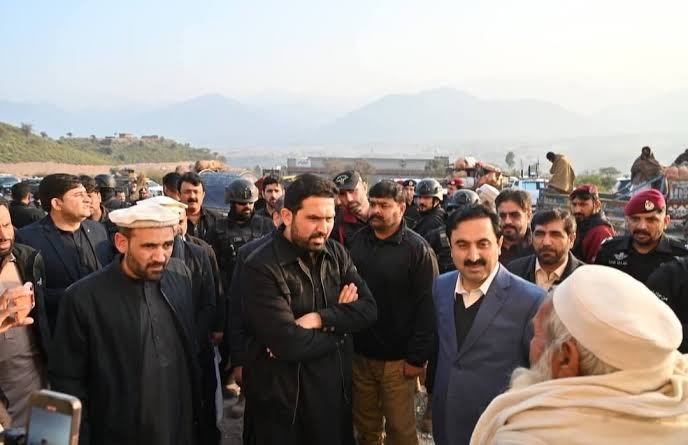
The Khyber Pakhtunkhwa Chief Minister’s public opposition to a proposed military operation in Tirah Valley has drawn renewed attention to longstanding disagreements over Pakistan’s counterterrorism policy in its former tribal regions, highlighting emerging tensions between elected leadership and the country’s security establishment.
Speaking on Sunday at the oath-taking ceremony of the Bara Press Club cabinet, Chief Minister Sohail Afridi questioned the effectiveness of repeated military operations, arguing that decades of security-led interventions have failed to deliver sustainable peace in the region.
He asked whether any assurance existed that the proposed operation would be the last, noting that past military campaigns had frequently been followed by renewed displacement.
Citing official figures, Afridi said more than 22 large-scale and thousands of smaller operations had taken place nationwide without resolving the underlying security challenges.
The Chief Minister also raised concerns about border management, questioning the effectiveness of the multi-billion-rupee fencing project along the Pakistan-Afghanistan border. If militants were able to cross through rivers and waterways, he asked, why those routes remained unsecured despite an extensive security presence.
He contrasted this with what he described as the state’s ability to quickly identify political protesters in major urban centers.
Afridi, a senior leader of Pakistan Tehreek-e-Insaf (PTI), said he had not been taken into confidence over the proposed operation. He described this as a disregard for the authority of an elected provincial government representing more than 45 million people.
He also alleged that attempts were made to prevent him from visiting internally displaced persons (IDP) registration centers in Tirah Valley last week, citing security and weather concerns. Despite those warnings, he said, he proceeded with the visit.
The Chief Minister rejected allegations linking him to militant or criminal networks, saying such claims were part of a broader effort to discredit him politically. He said his disagreement was not with counterterrorism efforts themselves but with an approach that, in his view, excludes political leadership and local stakeholders.
Afridi emphasized that military action alone could not address militancy and called for a broader strategy involving tribal elders, elected representatives, and local communities.
He criticized the earlier rehabilitation of former militants in tribal districts without what he said was adequate consultation with provincial authorities, while political activists, he added, continued to face legal and security pressure.
Referring to Tirah Valley as his ancestral region, the Chief Minister said the operation risked triggering a second large-scale displacement of local residents. He warned that repeated evacuations had eroded public trust and caused long-term social and economic harm.
Addressing journalists, Afridi urged media organizations to avoid what he described as stigmatizing portrayals of residents of the merged tribal districts, saying local populations were often unfairly associated with militancy and smuggling.
“This is not a new experience for the people of Tirah,” he said. “Displacement in the name of security operations has happened before, and it has not produced lasting peace.”
The remarks represent an uncommon public critique of Pakistan’s security-centric counterterrorism framework by a sitting provincial chief minister, particularly from a province that has experienced the brunt of militancy and military operations.
Whether the dispute leads to changes in policy or further strains relations between civilian and security institutions remains unclear, but the issue continues to resonate strongly in the former tribal districts, where displacement remains a recurring concern.


.jpeg)
Comments
No comments yet. Be the first 🙂