


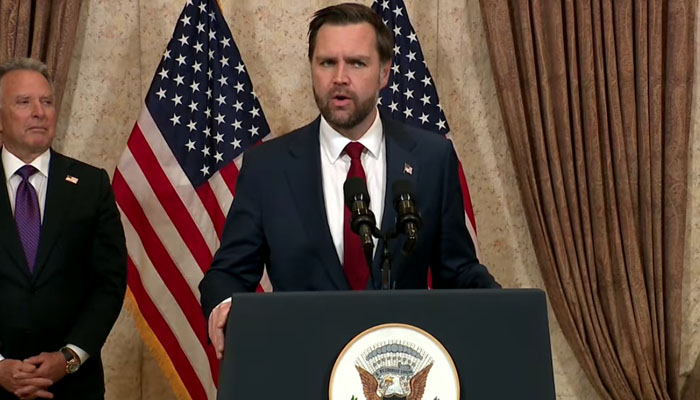
ISLAMABAD: Negotiations between the United States and Iran concluded without a final agreement after Tehran declined to accept Washington’s proposed terms, US Vice President JD Vance said on Sunday.
Speaking at a press briefing in Islamabad following extensive talks, Vance stated that despite “serious and constructive engagement,” the two sides were unable to reach a conclusive deal.
“We presented a final and best offer. It is now up to Iran to decide whether to accept it,” he said.
The US vice president thanked Prime Minister Shehbaz Sharif and Chief of Army Staff Field Marshal Asim Munir for facilitating the dialogue, acknowledging Pakistan’s role in bridging gaps between Washington and Tehran.
“Pakistan made sincere efforts to bring both sides closer. The shortcomings in the talks were not due to the Pakistani side,” Vance added.
According to him, the negotiations spanned over 21 hours and covered a range of critical issues. He said the United States participated in the talks in good faith and clearly outlined its conditions.
Also Read : Islamabad Hosts High-Level US and Iranian Delegations Amid Diplomatic Push
“The good news is that we had serious discussions with Iran. The bad news is that we could not reach an agreement — and I believe that is a worse outcome for Iran than for the United States,” he remarked.
Vance further said that Iran chose not to accept US conditions, and Washington would return without a deal.
“We came with a clear and simple proposal and have now placed our final offer on the table. We will see whether Iran accepts it or not,” he said.
He also noted that the Iranian delegation did not provide a clear commitment regarding nuclear weapons.
“We require firm assurances that Iran will not pursue nuclear weapons. That remains a core objective of the US president,” he emphasized, adding that Washington had made its “red lines” and areas of possible flexibility clear, while maintaining that certain issues were non-negotiable.
Meanwhile, Iran’s foreign ministry spokesperson offered a more nuanced view, saying that while consensus had been reached on several points, differences persisted on two key issues, preventing a final agreement.
“We anticipated that a single round of talks would not be sufficient to reach a comprehensive deal,” the spokesperson said, adding that the discussions were nonetheless “positive and conducted in a serious atmosphere.”
He further stated that consultations and diplomatic engagement with Pakistan and other friendly countries would continue in an effort to narrow differences and move toward a mutually acceptable outcome.

.jpeg)
Comments
No comments yet. Be the first 🙂