


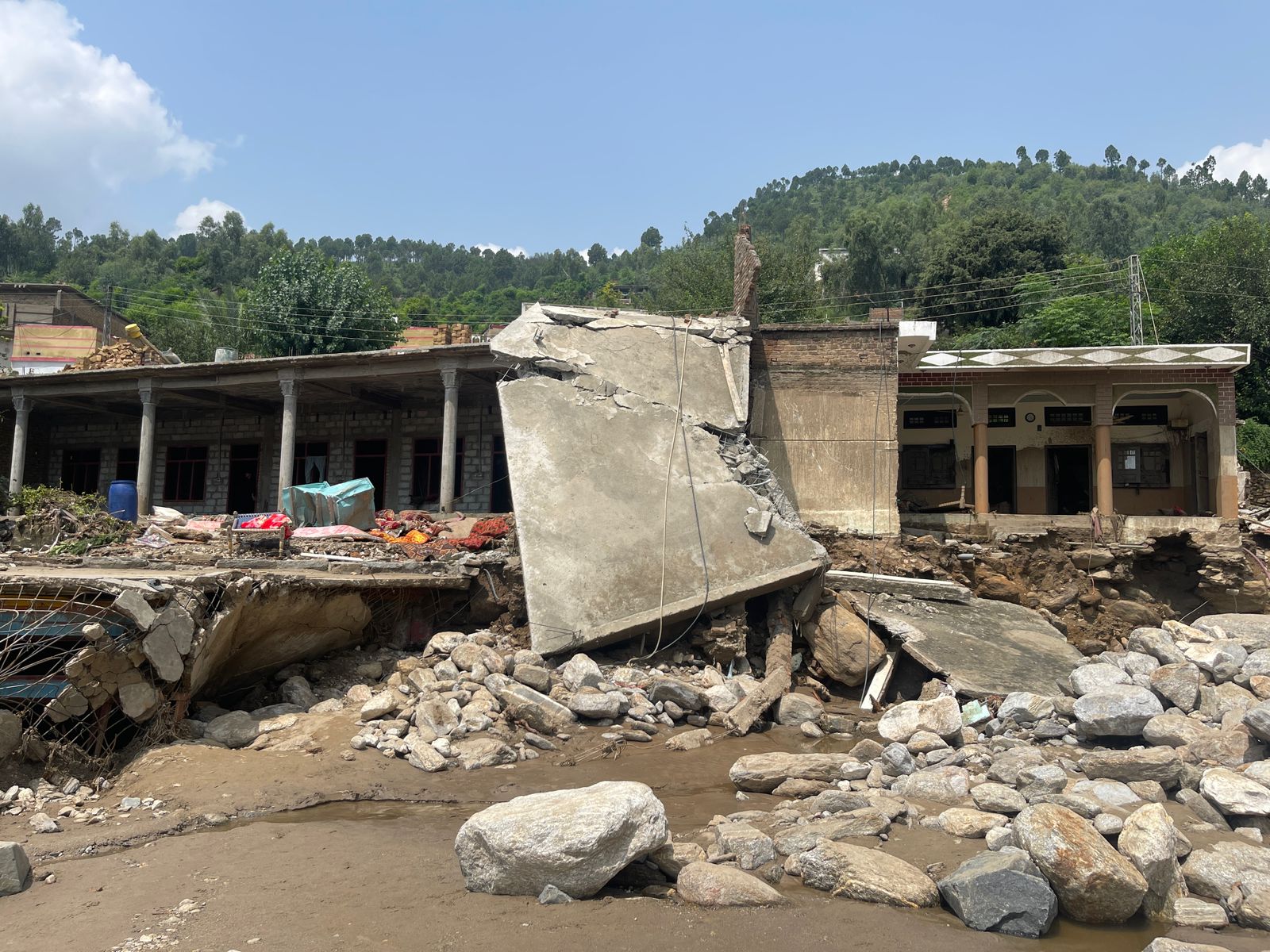
Khyber Pakhtunkhwa is witnessing a human tragedy caused by climate change, as devastating rains, a cloudburst, and flash floods on the night and day of August 15 claimed over 300 lives in the province’s northern districts, while more than 150 people remain missing.
The search for the missing is still underway. The affected districts include Swat, Bajaur, Bisham, Upper and Lower Dir, and Buner, with the most catastrophic destruction reported in Bishnoi village of Buner district, where more than 200 people have died.
How Is Climate Change Altering Our Weather Patterns?
Environmental journalist Dawood Khan explained that climate change is altering seasonal patterns in Khyber Pakhtunkhwa. This year’s monsoon is a prime example of these shifts. Normally, the monsoon season in the province begins in the first week of July, but this time, it started unusually early on June 22 and lasted longer than usual, with its sequence also disrupted. “These are the impacts of climate change that people are suffering from,” Dawood said, adding that the monsoon might extend into September.
He further stated that the recent floods and cloudbursts in Buner, Swat, Bajaur, and other districts are the consequences of these changes, urging authorities to take this issue seriously.
Bishnoi Village in Buner: The Epicenter of Devastation
Qaiser Alam, a resident of Pir Baba city in Buner district, one of the worst-affected area, shared the grim reality. He explained that Bishnoi village, located an hour’s walk north of Pir Baba, was once a picturesque valley with houses along the edges and streams flowing between mountains, creating a serene landscape.
Also Read: Sahar: The Afghan Artist in Pakistan Who Speaks for Her People Through Colors & Canvas
“On August 15, this beautiful village fell victim to a devastating cloudburst and now looks like a deserted ruin,” Qaiser said. According to local accounts, Bishnoi village has suffered the highest toll, with more than 200 deaths and nearly 150 people still missing.
The Heartbreaking Story of a Survivor from Bishnoi
“When the flood hit, I was in Lahore. It was 10 a.m. on August 15 when I received the news. I immediately left for my village and reached there at 2:30 a.m. that night. When I entered our hujra (guesthouse), I saw countless bodies lying there. Inside the house, there were 15 to 20 bodies,” recounted Salman Khan, a local from Bishnoi village and an elected local government representative.
He added, “The thought that all our women, children, and elders had been swept away by the flood was unbearable. Everywhere I looked, there were dead bodies. It was a sight one cannot describe.”
Pointing towards the rubble, Salman said, “This was my uncle’s house, where my nephew’s wedding was scheduled for August 16. Twenty-four members of my uncle’s family were swept away by the flood. We have recovered 20 bodies so far, while four are still missing.”
He further pointed to another house and said, “This belonged to our neighbor. Forty-one members of that family were swept away. Twenty-seven bodies have been recovered and buried, while the rest are still missing.”
Gesturing toward another collapsed house, Salman said, “Nine people from this family were swept away; seven bodies have been found, two are still missing. There is another house that was completely washed away along with five family members, whose bodies have yet to be found.”
He concluded with a heavy heart: “The survivors of Bishnoi village are searching for the remains of their loved ones.”
What Did Journalists Witness?
Senior journalist Aziz Buner was in Bishnoi on August 15 to cover the devastation. He described the village as once being a breathtakingly beautiful place, just 50–60 minutes from Pir Baba city, but now reduced to rubble.
“A small stream used to flow through the valley, but the cloudburst and floods have turned it into ruins. Massive boulders brought by the flood now cover areas that were once lush fields and greenery. Every household is mourning, some for brothers, some for parents, wives, or children,” Aziz said.
He added that rescue operations are underway, mainly driven by government and non-government organizations, but the destruction of roads, mobile networks, and electricity systems has made operations extremely challenging. “If heavy machinery is brought in for debris removal and the search for missing persons, it will provide some relief to the people,” he stressed.
Journalist Anwar Zeb added that Bishnoi village had over 100 houses, and all but four were completely destroyed by the flood. He also highlighted another critical issue: “The clean drinking water system has been destroyed, making access to potable water a major problem. The government and welfare organizations must prioritize providing clean drinking water.”
What Is the Khyber Pakhtunkhwa Government Doing?
Chief Minister Ali Amin Gandapur visited flood-affected areas of Malakand Division, including Buner, and chaired an emergency meeting. He offered prayers for those who lost their lives in the disaster and was briefed on the destruction, rescue efforts, and relief operations.
Officials informed him that in Buner alone, 5,380 houses were damaged across seven village councils due to the cloudburst, with more than 209 confirmed deaths, 134 missing persons, and 159 injuries reported.
Relief operations involve 10 excavators, 22 tractors, 10 de-watering pumps, 5 water bowsers, and 10 bulldozers. Over 223 rescue personnel, 205 doctors, 260 paramedics, 400 police officers, 300 civil defense volunteers, and three army battalions are engaged in the efforts.
Essential supplies such as food, healthcare, tents, blankets, and mattresses are being distributed.
Roads have also been cleared, including 6 km of the Pir Baba road and 3.5 km of the Gokand road, along with debris removal at 15 landslide points. Emergency relief has been declared in eight affected districts, and a search operation for the missing continues. Around 3,500 stranded people have been safely evacuated.
The chief minister assured that no effort will be spared for the rehabilitation of affected families and restoration of infrastructure. Compensation for victims will be provided without delay, and Rs. 1.5 billion has been released for this purpose.
What Is the Overall Situation?
According to the Provincial Disaster Management Authority (PDMA), rains and flash floods have so far claimed 314 lives across Khyber Pakhtunkhwa, leaving 156 people injured. Among the deceased are 264 men, 29 women, and 21 children, while the injured include 123 men, 23 women, and 10 children.
So far, 159 houses have been damaged, of which 97 are partially and 62 completely destroyed. PDMA confirms that Buner remains the hardest-hit district, with over 209 deaths reported so far.
The authority has warned of more heavy rains between August 17 and 19, with the current spell expected to continue intermittently until August 21.


.jpeg)
Comments
No comments yet. Be the first 🙂