


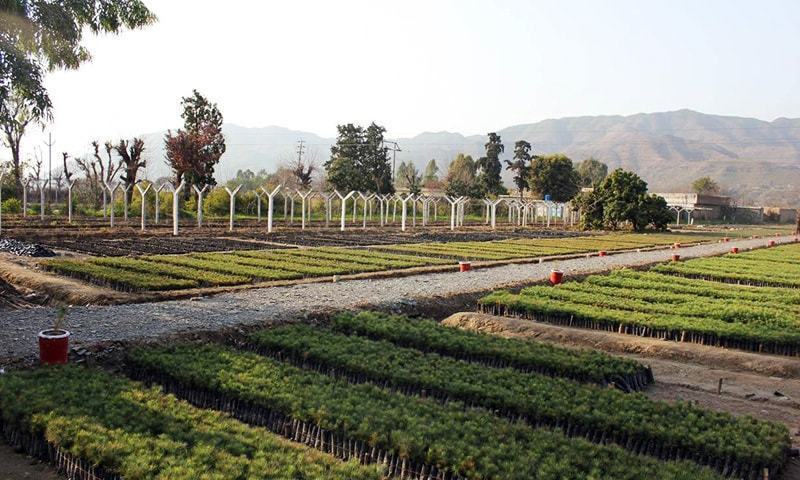
In this regard, Professor Dr. Nafees from the Department of Environmental Sciences at the University of Peshawar shared his views, stating that the Khyber Pakhtunkhwa (KP) government is taking the issue of climate change seriously and has already initiated several measures while continuing further efforts to cope with its impacts.
Some of the key steps are as follows:
Plant for Pakistan Campaign
The provincial government has played an active role in programs like Plant for Pakistan to restore forests and promote afforestation.
A notable example is the Billion Tree Tsunami under which millions of trees were planted in KP, helping to reduce carbon emissions and improve environmental balance.
Focus on Renewable Energy
Khyber Pakhtunkhwa is working on two major sources of renewable energy: hydropower projects and solar energy projects.
Several projects have been launched in this regard, such as on the Swat River and Panjkora River. Additionally, the Dasu Hydropower Project, the largest project of the province, is nearing completion.
The use of solar energy is also being promoted, especially in rural areas. Examples include solar-powered tube wells for farmers and solar panels installed in mosques.
Policy-making for Climate Change
The KP government formulated the Provincial Climate Change Policy in 2022 and has also developed an action plan for its implementation. Substantial work is being done on it.
The aim of the policy and action plan is to reduce the impacts of climate change and prepare the public accordingly. Under this framework, efforts are being made to adapt agriculture, water resources, and infrastructure to climate change.
Disaster Management Plan
According to Dr. Nafees, the province has established a dedicated institution for disaster management. Improved disaster management plans have been prepared to deal with floods, landslides, and other natural calamities. This institution also runs awareness campaigns through social and print media.
Moreover, it reaches out to provide assistance where needed. Each year, it prepares plans to cope with monsoon rains. It also trains local people under Community-Based Disaster Risk Management by working closely with communities.
5. Water Conservation Measures
Under water resource management, work is underway on the restoration of dams and canals. Alongside this, projects for water harvesting have been initiated to store rainwater. However, progress on water harvesting has been slow and needs to be accelerated.
Public Awareness Campaigns
According to Professor Nafees, the government has launched various campaigns to raise public awareness about climate change, spreading messages through schools, colleges, and media.
BRT and Solar-Powered Vehicles
The BRT system is already functional, while solar-powered vehicles have only just been introduced. However, efforts in this area need to be accelerated.
The KP government considers climate change a serious challenge and is adopting a comprehensive strategy to address it. However, there is a need to enhance resources and speed up implementation in order to reduce its negative effects.
A few days ago, the KP government decided to establish an autonomous Climate Action Board to deal with climate change.
The board will comprise 8 administrative secretaries and 4 representatives from the private sector. Its mandate will include policy formulation, research, coordination with international organizations, preparing a greenhouse gas inventory, and ensuring inter-departmental linkages.
KP has long been vulnerable to climate change, suffering both human and financial losses as a result.
How useful will the Climate Action Board be for the province?
Climate change journalist Asif Mehmood told TNN that the establishment of such an institution is a timely necessity. While the government’s step is commendable, the climate change policy was first introduced in 2016, yet KP has still not been able to effectively deal with climate change.
Every year, the effects worsen. Institutions lack proper coordination; when we seek comments from concerned departments, they often respond by saying the matter is not their mandate. In my opinion, the policy itself must be viewed through the lens of climate change.
According to Asif Mehmood, similar boards and climate cells were also created in the past, but they did not produce tangible results. Therefore, if the KP government has now decided to take climate change seriously, it must make these institutions effective.
Since previous boards and climate cells failed to deliver, this new board cannot be deemed successful until it becomes fully functional and produces visible outcomes.
Only time will tell how useful the Climate Action Board will be. However, each year, monsoon rains prove devastating in KP. This year alone, torrential rains and urban flooding in different districts claimed 416 lives and left 135 injured. According to the PDMA report, 2,562 houses were damaged.
In 2025, several incidents of heavy rains and floods occurred, often attributed to lightning strikes and cloudbursts. Notable among these were in Buner, Babusar Top, Naran, Swat, and Bajaur, although many other areas also witnessed such events. These disasters claimed hundreds of lives, with Buner suffering the most severe destruction from a cloudburst this year.
The real question is: why do cloudbursts occur, and how can we prevent their devastating effects? Is it possible to develop an alert system for this?
It must be remembered that sudden flash floods are not caused by cloudbursts alone; there are other contributing factors as well. Government institutions face multiple challenges in this regard, which require urgent solutions.





.jpeg)
Comments
No comments yet. Be the first 🙂