


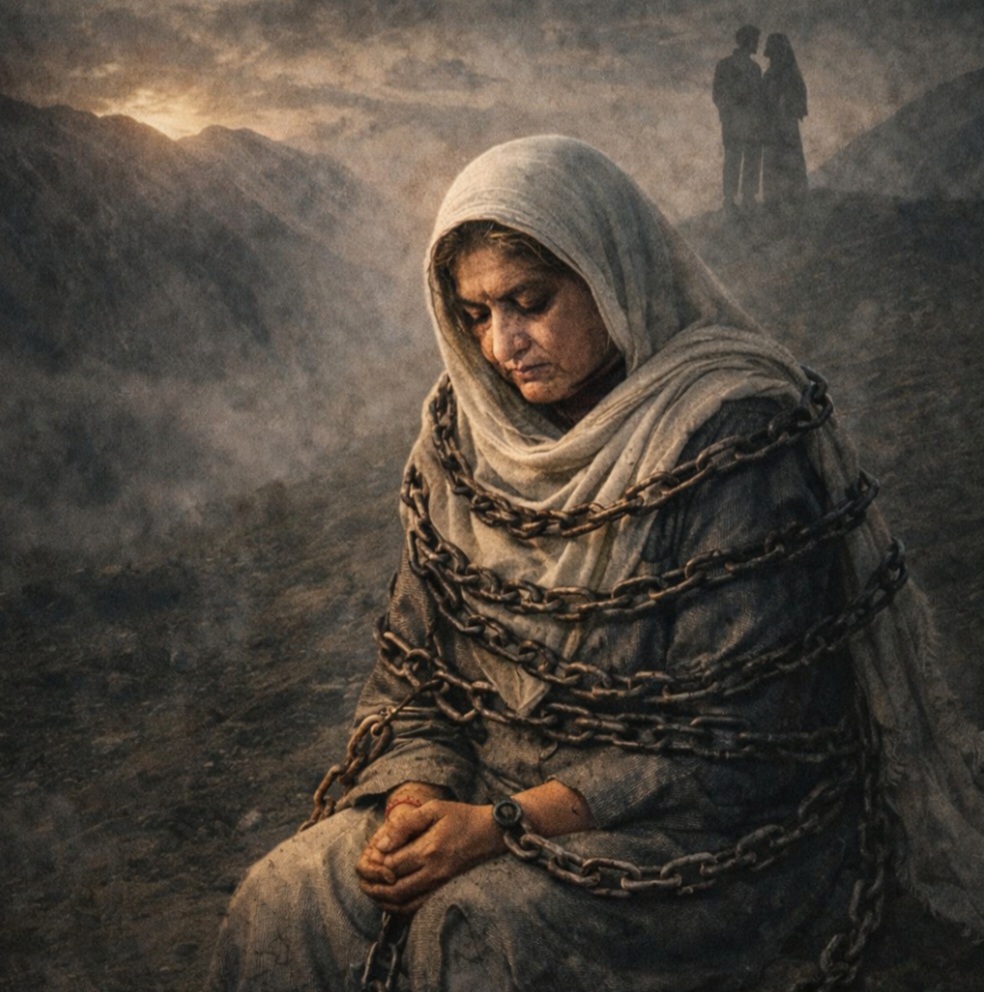
Silence in Gulzarin’s Room:
There is silence in Gulzarin’s room. The walls are bare, and instead of colorful clothes, the wardrobe holds files, medicines, and the story of a quiet life spanning decades. Gulzarin, who lives in the Manglor area of Swat, made a promise in her youth whose cost she is paying today in old age through solitude. That promise was called Sunday Bakhal.
A Silent Tradition in Swat:
Swat, the beautiful valley in Khyber Pakhtunkhwa, is known for its lush hills, flowing streams, and strong family systems. Yet within this society exists a quiet tradition that is rarely spoken about openly, known locally as Sunday Bakhal, meaning the sacrifice of one’s youth. On the surface, Sunday Bakhal is a practice taken in the name of selflessness and service, but in reality, it robs a woman of her youth, her right to marriage, motherhood, and personal future.
Under Sunday Bakhal, women are pressured—through family pressure, emotional blackmail, and economic compulsion—not to marry. Although the decision is usually presented as a woman’s choice, in reality it is a silent agreement that leaves almost no room for refusal.
Also Read : The Price of Truth: Journalists Under Pressure in Tribal Districts
The Killer of Silent Youth:
This practice is not limited to remaining unmarried; a woman’s entire life can be sacrificed for the family. Under this vow, a woman stays unmarried all her life to care for her parents, brothers, or other relatives. Social circles have referred to this tradition as “the killer of silent youth.”
Sunday Bakhal was particularly common in Swat during the 1980s and 1990s. During that period, a strong patriarchal system, limited educational opportunities, and women’s economic dependence strengthened this tradition. At the time, Sunday Bakhal was presented as a matter of family honor, responsibility toward siblings, and service to parents, and questioning it was almost impossible.
Financial Gain and Family Pressure:
Social worker and head of the Khwendo Jirga organization, Tabsum Adnan, describes Sunday Bakhal as open injustice against women. According to her, the main reason behind this tradition is financial gain and property.
Tabsum Adnan explains that Sunday Bakhal is not done with the woman’s consent. Women are forcibly prevented from marrying so that property remains with brothers or male relatives.
She adds that women who are financially independent or employed in government jobs are more likely to be targeted by this practice. Women who earn an income are pressured to perform Sunday Bakhal for the family, leaving them with no way to refuse.
Gulzarin’s Sacrifice and the Journey of Loneliness:
Gulzarin from Manglor is a living example of this tradition. She says that at first, the decision felt like a temporary sacrifice, but over time it turned into a permanent void.
Gulzarin explains: “I am the eldest among eight sisters and one brother. I worked a government job. My family told me, ‘Your brother is young; you should support the family and do Sunday Bakhal.’ Out of compulsion, I agreed to it.”
She adds that her job kept her busy, but after retirement, the loneliness intensified.
“Now my body is weak, going outside is difficult. My sisters are busy with their own households. Often I think, I wish I had thought about my own life too.”
Resistance from the New Generation:
Although Sunday Bakhal was once common, today’s new generation refuses to accept it.
Mina, a resident of Charbagh, who completed her BS in Pakistan Studies in 2025 and is preparing for the PMS exam, says that she also faces pressure to adopt Sunday Bakhal, but she rejects it.
Mina says:
“My relatives ask me to do Sunday Bakhal, but I have always made it clear that this is a cruel tradition and I cannot be a part of it. Fortunately, my mother also stands with me.”
Religious and Legal Perspective:
From a religious perspective, Sunday Bakhal is unacceptable. Religious scholar Nadia says:
“There is no tradition called Sunday Bakhal in Islam. Allah has made marriage a desirable act. Serving parents is obligatory, but this does not mean a woman should be deprived of marriage for her whole life. This is a non-Islamic practice.”
Legal Aspect:
Advocate Malik Saddam Hussain considers Sunday Bakhal a serious social and legal issue.
He says:
“Initially, Sunday Bakhal was considered a voluntary act, in which some women would relinquish their property rights in favor of their brothers after marriage. But over time, this practice was misused. Particularly, men with large property holdings began forcibly imposing Sunday Bakhal on their sisters to deprive them of inheritance.”
Advocate Malik Saddam Hussain adds that this tradition still exists in many rural areas of Swat. Decisions are usually made within the household, and women do not seek legal help. Yet, countless cases reach us where brothers force their sisters to declare that they accepted Sunday Bakhal, depriving them of property rights.
He further says:
“If a woman is forced into Sunday Bakhal, she can approach the court. Courts often dismiss such coerced agreements and restore women’s legal rights. A brother can face up to ten years in prison for depriving his sister of property.”
According to him, Sunday Bakhal is not merely a tradition but an attack on a woman’s right to life. As long as women remain silent, this injustice in the name of tradition will continue. Awareness, resistance, and legal action are the only ways to break this silence.
The Need for Awareness and Resistance:
Sunday Bakhal is not just a tradition but an attack on women’s right to life. As long as women remain silent, this injustice in the name of tradition will continue. Awareness, resistance, and legal enforcement are the only ways to break this silence.
Gulzarin’s loneliness and Mina’s resistance demonstrate that the story of Sunday Bakhal reflects both oppression and hope for its end.
The tradition of Sunday Bakhal has left hidden scars on the lives of women in Swat. This sacrifice comes at the cost of youth, marriage, and personal dreams. But with the growing awareness of the new generation, family support, and legal knowledge, this tradition is being challenged.
Ending this oppression, rooted in the mountainous areas of Swat, is possible only through women raising their voices, spreading social awareness, and implementing the law.



.jpeg)
Comments
No comments yet. Be the first 🙂