


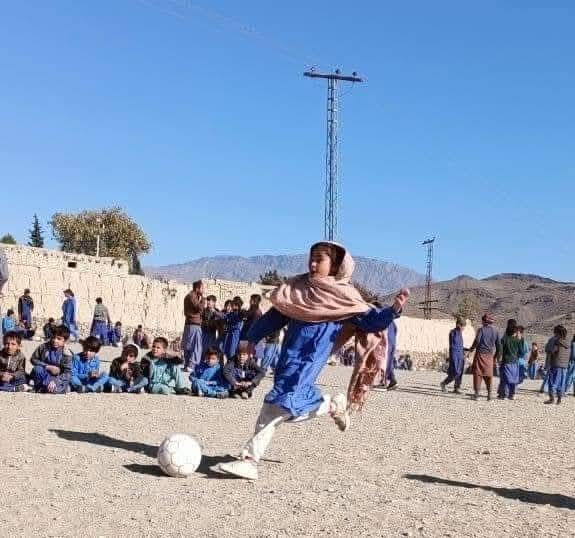
In the dusty alleys of Tanai, South Waziristan, when a little girl kicks a football, the world seems to pause for a moment. People applaud her, calling her “the football girl.” Big names like Shoaib Akhtar share her picture on social media. Praise pours in, claps echo everywhere.
But hidden in the movement of that football is a silent sorrow that no one notices—the sorrow reflected in Asma Hafiz’s eyes. It is the pain of being deprived of education. No one sees that in her gaze it is not a football she dreams of, but an open book.
Her name is Asma Hafiz, and her greatest deprivation is this: she wants to study, but she cannot.
Asma dreams of becoming a doctor, of easing people’s pain. Yet in her own area, knowledge itself is rare. On paper, official records show hundreds of schools in South Waziristan, but in reality these buildings lie abandoned—like graves of dreams. The absence of a girls’ high school in Tanai is a lock on Asma’s educational journey, a lock for which this little girl holds no key.
Also Read: Girls Students Protest at Igloo Gate in Wana Over Transport Restrictions, Demand Smooth Entry
Asma’s words are not loud slogans; they are a soft yet deeply truthful voice. She says: “People call me the football girl, but no one asks why there is no book in my hands. I can kick a football, but I have never kicked away my education. I want to study, I want to carry a schoolbag, but in my village no door of knowledge opens.”
Four years have passed—four years that lay the foundation of a child’s life. But for Asma, these years have turned into nothing but waiting: waiting that perhaps a way will open, perhaps someone will hear her heart’s plea and turn her dreams into reality.
Despite disappointment, Asma has not given up. She turned to online education—YouTube teachers, a small mobile screen, and fragile hopes. But even the internet failed to support her in the mountains of South Waziristan.
Sometimes the signal disappears, sometimes the sound cuts off. Amid the claims of a “Digital Pakistan,” a little girl keeps trying to piece together her future, but every time, the chain breaks.
The silence of Asma’s brother becomes a cry in itself. He writes: “When Asma asks me, ‘Brother, when will I go to school?’ my tongue falls silent. This is not my weakness; it is the failure of a system that could not give my sister her basic right.”
A few kind-hearted people, like Malik Noor Rehman and the late Shah Hussain, tried to get Asma admitted to a Danish School. But files, rules, and cold bureaucracy exhausted this small hope as well. Another dream became entangled in the complexities of the system.
Today, Asma Hafiz’s eyes are fixed on the Prime Minister of Pakistan. Her appeal is neither big nor complicated. She only wants to be allowed to study, to get admission to a Danish School, and for the doors of education to open in her area.
This question is not Asma’s alone; it is a test for the entire society. Because when a little girl’s dream is shattered, it is not just one individual who is deprived—an entire nation’s future slows down.
Today Asma kicks a football, but the real question is: will we ever place a book in her hands?

.jpeg)
Comments
No comments yet. Be the first 🙂