


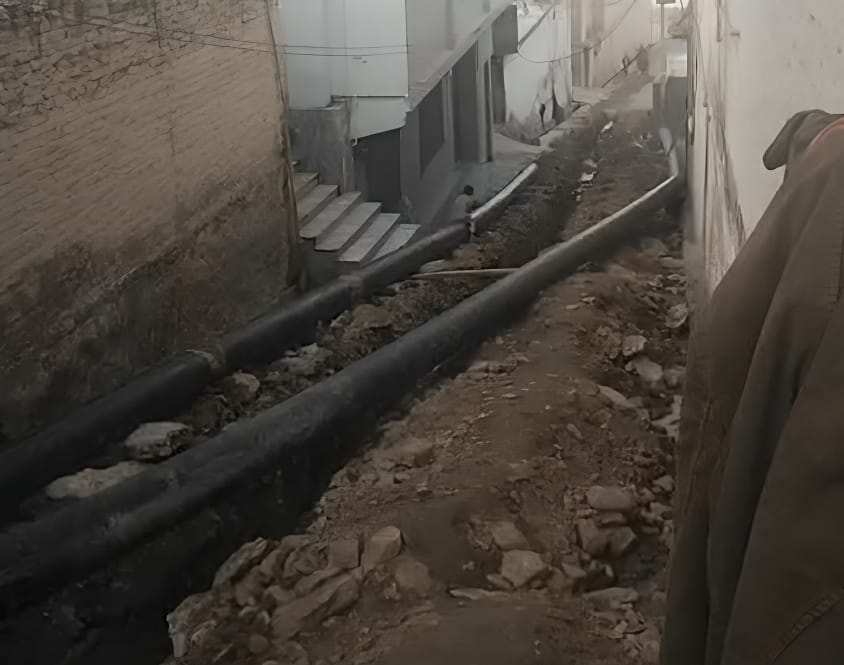
Mingora, once renowned for its natural beauty, lush green hills, and tourism significance, not just in Swat but across the country, is currently facing severe difficulties due to a major development project. The city, once known for its wide roads, smooth traffic, and easy daily life, now presents a scene of dug-up pits, traffic jams, and broken roads.
The ongoing excavation in different parts of the city, carried out under a project to provide clean drinking water, may offer convenience in the future. However, at present, it has become a major challenge for the residents.
Women, patients, children, and the elderly are the most affected, as their daily lives have been severely disrupted. Citizens claim that before starting the work, there was neither consultation with them nor consideration of the problems they would face.
Public Problems and Ground Realities:
Local resident and head of the Khwindo Jirga organization, Ms. Tabassum Adnan, said that this excavation is not a new development but has been ongoing for quite some time. Several months have passed, yet authorities have never tried to understand what difficulties the public is facing.
According to her: “At first, we thought maybe they would consult us, but nobody even bothered to ask. Excavations in front of our homes have become so deep that it has become difficult to pass, especially for women.”
Tabassum Adnan shared that she herself suffers from kidney disease and has undergone surgery. Navigating the uneven, dug-up roads has become extremely painful for her. She said this issue is not limited to her alone; children and other women face these difficulties daily.
She added that recently, pregnant women experienced the greatest difficulty, as some areas were inaccessible to ambulances or regular vehicles.
“One day we faced a major loss when my nephew’s operation was delayed because the ambulance could not reach on time due to the poor condition of the roads.”
According to Tabassum Adnan, the authorities have shown discriminatory behavior. She alleged that the roads leading to government officials’ and senior authorities’ homes were left untouched, while roads in poorer areas were dug up and abandoned.
During rainy days, the situation worsens. Water accumulates everywhere, accidents occur, and people fall into pits. She noted that women have been confined to their homes for several days—they cannot go to hospitals or their workplaces.
Health, Economy, and Government Perspective:
Tabassum Adnan also expressed serious concerns about the quality of drinking water. She pointed out that a previous hand-pump project had failed, with water often being foul-smelling and dirty.
“We need to be shown proof that the water is actually clean. If test reports are presented to us, we will accept it; otherwise, why should we risk our health and that of our children?”
She feared that the water could become contaminated due to its proximity to sewage lines, raising the risk of various diseases.
The public’s concerns about drinking water quality are not just fears—they are serious public health issues. Experts warn that if water supply projects lack transparency and proper quality testing, the consequences directly affect citizens’ health, potentially causing long-term and dangerous effects.
Medical expert, former MS of Khwazha Khela Hospital and lecturer at Swat Medical College, Dr. Fazal Hanan, said that contaminated water can pose a silent threat to human health. According to him, using unhygienic or substandard water can lead to cholera, diarrhea, various viruses, and hepatitis A and B.
Business activities have also been affected by the excavation. Akhtar Ali, a farmer from Charbagh, said he used to come to Mingora daily to sell his vegetables, earning a decent profit.
“Earlier, this journey would take one hour, but now the same distance takes three hours. Sometimes, the entire day is spent in traffic. Being a poor man, I have stopped coming to Mingora for the past two months.”
He added that poor roads and traffic have affected not only his business but also reduced the number of buyers. Promises to complete the work are made regularly, but action is hardly visible.
Government Response:
The administration acknowledged that the ongoing excavation is causing temporary difficulties. However, authorities stated that the project was initiated to meet the city’s future water needs and address long-term water scarcity.
General Manager and Chief Engineer (Operations & Engineering Services), Zeeshan Pervez, told TNN that the project is being carried out under the Khyber Pakhtunkhwa Cities Improvement Project (KP-CIP), which includes Mingora, with a total cost of 3 billion PKR.
He explained that a water treatment plant is being constructed in Gashkud, from where pipelines will distribute water to tanks in different areas, creating a network for water supply.
According to Zeeshan Pervez, some delays occurred due to flood damage to imported pipelines, but work has now resumed. He stated that traffic is restricted to avoid further delays and ensure the project is completed quickly. Work is being conducted on main roads at night to minimize public inconvenience. Main roads are expected to be completed by the end of this month, while the remaining project will be completed within the next three months.
He added that over 500 complaints have been addressed so far, while delays in some areas are due to local disputes. After excavation, soil is refilled within three days, and the water supplied is completely clean and safe for drinking, posing no risk of disease. He further stated that if any citizen wishes to conduct a water test independently, the authorities are ready to facilitate it.


.jpeg)
Comments
No comments yet. Be the first 🙂