


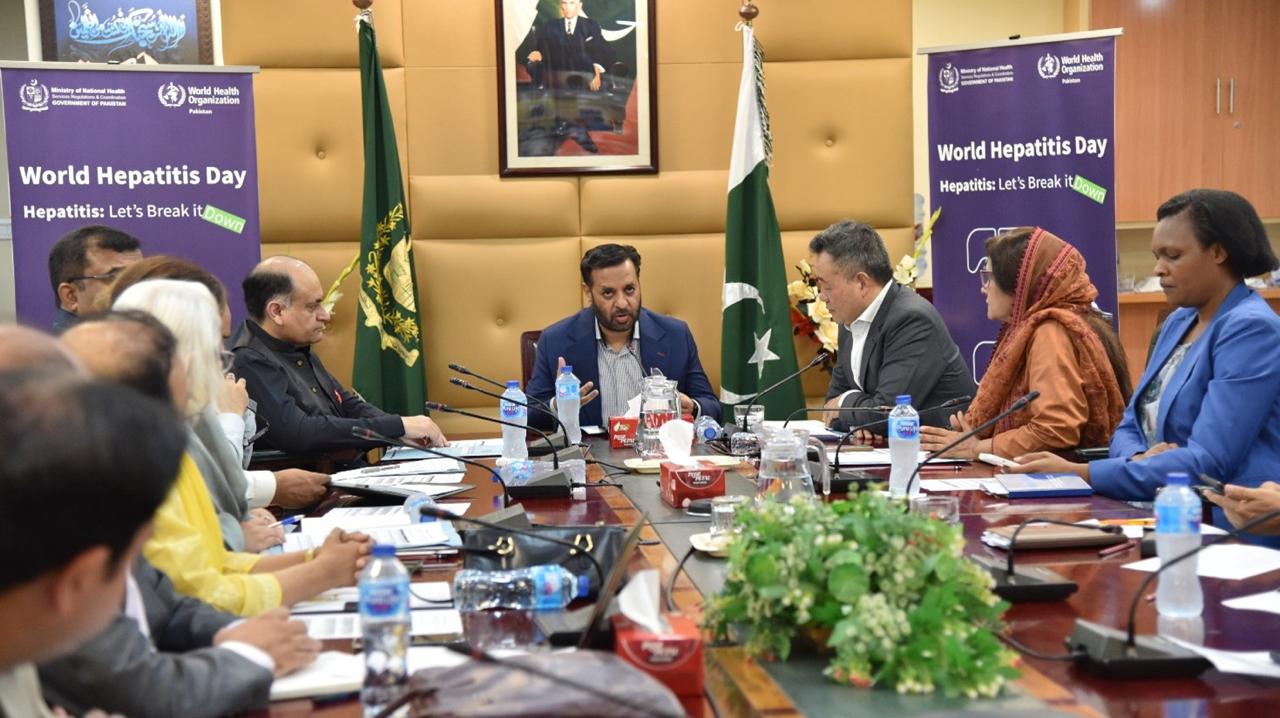
In a bold step toward eliminating one of the country's deadliest diseases, Pakistan’s Ministry of Health, in collaboration with the World Health Organization (WHO) and key partners, has pledged to accelerate efforts to eliminate hepatitis C. The renewed campaign, spearheaded under the Prime Minister’s National Programme for the Elimination of Hepatitis C, aims to prevent 850,000 deaths and 1.1 million new infections by 2050.
The announcement was made at a high-level event chaired by Federal Health Minister Syed Mustafa Kamal. Emphasizing the urgency of the initiative, the minister said, “This isn’t just a ceremony, it’s a mission. We are racing against time. Every day that we delay, more lives are lost. My team and I will work tirelessly to meet our goal. Inshallah, we will leave no stone unturned.”
He added, “The fight against hepatitis is not a job, it’s a passion and a responsibility. Our Prime Minister has personally engaged with global leaders, including the President of Egypt, to learn from successful elimination models. Now, it’s time for all stakeholders to unite for the health and future of our people.”
Also Read: Maternity Leave: Are Women in Private Sector Any Less Human?
The renewed push coincides with World Hepatitis Day (28 July), and brought together national and international public health experts. They stressed that every dollar spent on hepatitis prevention generates an elevenfold return in economic benefit. In addition to saving lives, the initiative could save Pakistan an estimated PKR 3.3 billion (USD 11.6 million) over five years by reducing treatment and hospitalization costs.
Data presented at the event projected that by 2030, the Prime Minister’s Programme could save 150,000 lives, prevent 210,000 new infections, and avert 90,000 liver cancer cases and 71,000 instances of cirrhosis.
WHO Representative in Pakistan Dr. Dapeng Luo highlighted the human toll of hepatitis, stating, “Every 30 seconds, someone dies of hepatitis-related complications. That means at least eight people will have died by the time I finish speaking. But together, we can change that. Prevention is our strongest weapon, and WHO stands with Pakistan in this mission.”
Pakistan currently bears the heaviest burden of hepatitis C worldwide, with nearly 10 million cases, one-fifth of the global total. Approximately 110,000 new infections occur annually, largely due to unsafe medical injections (62%) and injection drug use (38%).
Under the theme “Let’s Break It Down,” WHO is calling on governments to simplify and integrate hepatitis services into routine healthcare, including vaccination, safe injection practices, harm reduction, and expanded access to testing and treatment.
WHO reaffirmed its full support for Pakistan’s elimination efforts. The national programme targets testing 82.5 million people aged 12 and above (50% of the eligible population) and providing treatment to 5 million people by 2027.
With a strategic blend of political commitment, scientific guidance, and economic foresight, Pakistan and WHO are determined to turn the tide against hepatitis C, and save hundreds of thousands of lives in the process.




.jpeg)
Comments
No comments yet. Be the first 🙂