


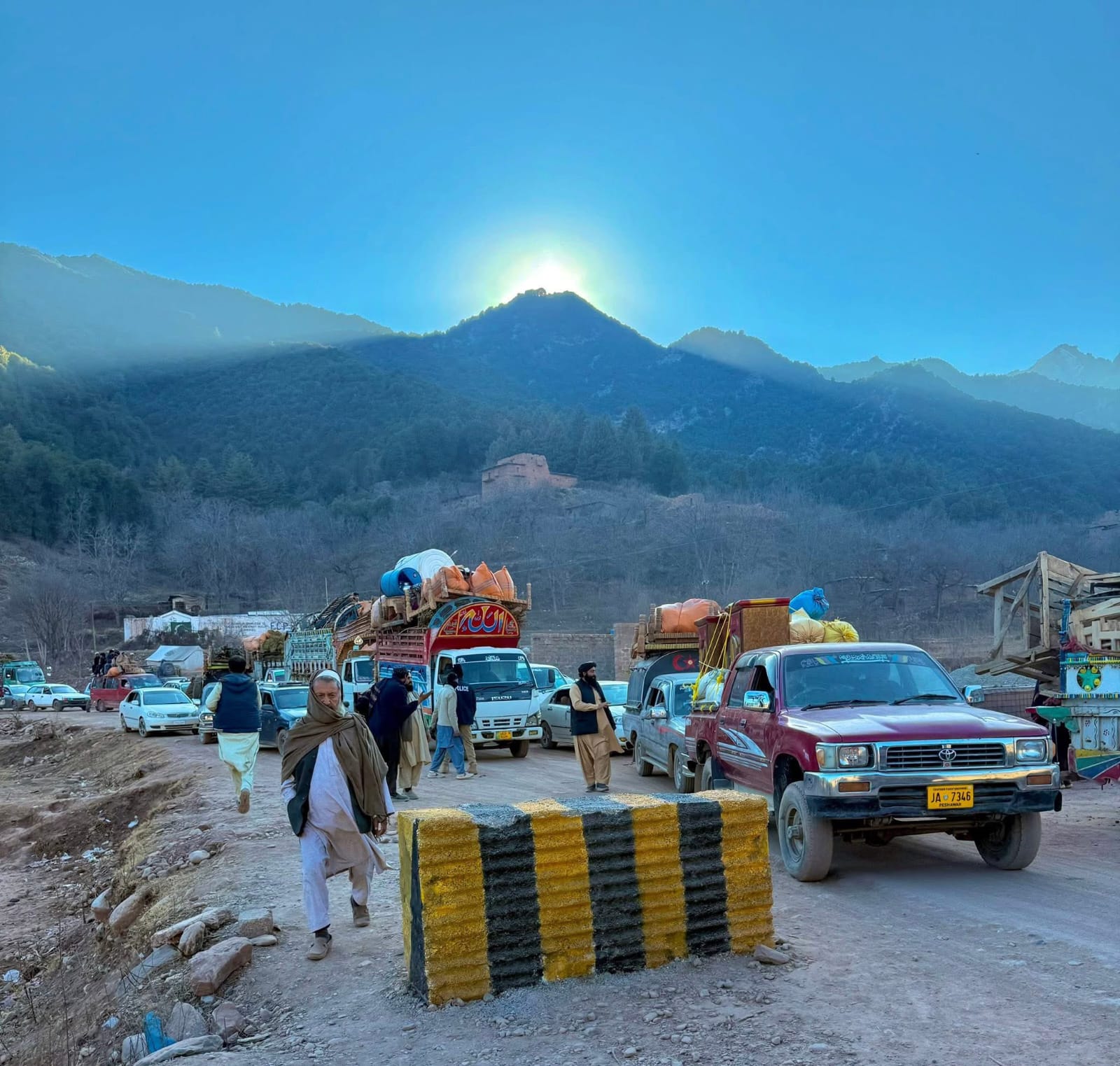
Over the past few days, the situation in Tirah Valley has been making headlines — blocked roads, severe cold weather, fear, and uncertainty dominating the scene. This was not merely news from a remote valley; it felt like a haunting image that left a deep mark on the mind and heart, as if time itself had repeated.
While looking at Tirah Valley, my mind unconsciously drifted to Swat, where years ago armed conflict transformed an entire region. I was only six years old at the time, and I did not experience the war as a historical event, but as intense fear and anxiety — in the silence, in the conversations of elders, and in the suffocating feeling that settled in the heart with every piece of news.
Although the armed conflict in Swat ended in 2009, the effects of war are still alive today. It feels as though the war is over, yet fear continues to linger in people’s hearts and minds.
This is the aspect that is rarely discussed — that life after war is itself a long and difficult trial. Women and children suffer the most, forced to live under the shadow of fear and insecurity.
Seeing the current situation in Tirah Valley, the surprise is not just that hardships exist, but that after ten or fifteen years, the same scenes are reappearing.
In 2013, the people of Tirah Valley had also left their homes and sought refuge in camps or with relatives, hoping that lasting peace would be established in their region. But this was a dream far removed from reality.
Also Read : Between policy and pain: The human cost of Afghan refugees’ return
Even today, during displacement, the same blocked roads, the same uncertainty, and the same panic are visible. It seems that some regions do not move forward in time but remain trapped in a circle.
Tirah Valley is among those areas of Khyber Pakhtunkhwa that are geographically difficult, climatically harsh, and administratively often neglected.
For decades, people here have lived amid insecurity, limited facilities, and continuous crises. The recent snowfall has once again made it clear that when natural disasters and human conflict occur together, the greatest burden falls on ordinary people.
The current situation in Tirah Valley cannot be viewed as merely a temporary crisis. Behind it lies the security situation that emerged in the tribal areas after 9/11.
Although full-scale war-like conditions have been rare, periodic clashes, military operations, and displacement have permanently affected people’s lives.
The situations in Swat and Tirah Valley may differ geographically, but there is a deep similarity in their stories. In both places, ordinary people were not decision-makers, yet they suffered the most.
Children saw fear instead of playgrounds, and women took on extra responsibilities to protect their families while trying to survive. In both cases, peace was defined only as the end of war, not the restoration of life.
On one hand, this is the reality, but on the other hand, the statements emerging amid political tensions between the federal and provincial governments regarding Tirah Valley show a lack of capacity to understand the human crisis here.
Thousands of families are caught between life and death. People are helpless — they do not need political rhetoric; they need practical action.
State-level relief efforts and security measures are essential for displaced families from Tirah Valley, but a lasting solution is not possible without education, healthcare, infrastructure, and psychological rehabilitation.
If an area is repeatedly viewed only through the lens of security, its social problems remain unresolved. Tirah Valley today appears to be standing where Swat stood years ago.
The question is not why wars happen, but why life is not rebuilt after wars end. If the same scenes return every few years, then peace does not become a permanent state — it turns into a brief pause.
Note: This article reflects the personal opinion of the writer and does not necessarily represent the views of the organization.

.jpeg)
1 Comments
my tender and buy cars 15!