


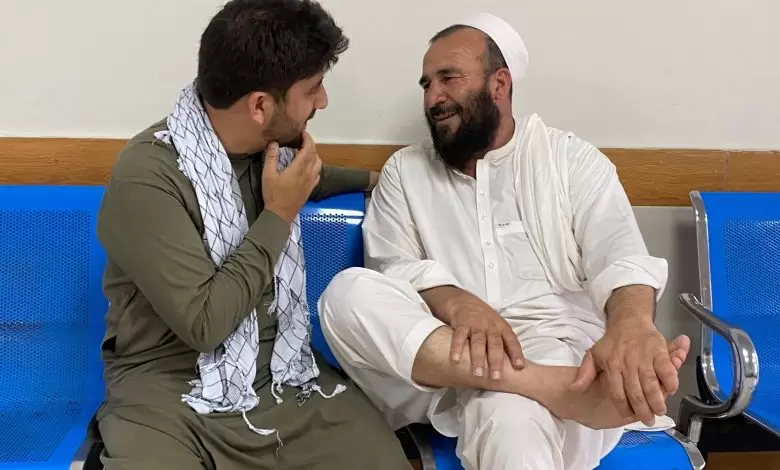
In the cold, silent corridors of Lady Reading Hospital, Peshawar, where the struggle between life and death is a constant, I met Sheikh Jan Badshah, the brother of Shaheed Maulana Khanzeb. There were no tears in his eyes, yet sorrow was evident in every word he spoke. He had come from Bajaur to tend to his son, Shahsawar, who had been struck by five bullets in the assassination attempt on Maulana Khanzeb.
Just 21 years old, yet the father’s strength was unbelievable, like a mountain of pain. When I asked how his son was, he replied, “Insha’Allah Shahsawar will recover, but my brother will never return!” That very day, just before the martyrdom, he had been with Maulana in his hujra. When someone asked about his son, he said, “I don’t know about him, haven’t had any contact… My brother has been martyred.” It was a reflection of a brother’s unparalleled love.
In a calm voice, Sheikh Jan Badshah shared, “We were six brothers. One had already passed away. Maulana Khanzeb was the youngest. He was the backbone of our family, honest, fearless, and the one we all trusted. I always worried for his safety.” He would recite special prayers daily, spiritually protect Maulana’s vehicle, and take every precaution whenever he left.
Even when he was burdened with worries, Maulana never said a word to the family so as not to trouble them. Amid the worsening situation in Bajaur, he remained silently active. Their elder brother, Sheikh Jehanzada, served as his political advisor, and every decision was made in consultation with him.
Also Read: Japan Pledges ¥379 Million for Pakistani Civil Servants' Higher Education Under JDS Scholarship
Then came that night. It was a Friday, and as per tradition, the entire family had gathered at the mosque after the Isha prayers. The Khatm-ul-Qur’an was completed, Maulana Khanzeb gave a Qur’anic lesson, and then sat aside with Sheikh Jehanzada to discuss the current situation. I had just finished reciting when I overheard Maulana say, “The coming days are dangerous. Something big might happen.” I was taken aback. When I questioned him, he brushed it off, but a wave of restlessness filled my heart. I spoke to him in a stern tone: “You’re not just ours anymore—you are now the hope of the entire Pashtun nation. If anything happens to you, it would be a loss for the whole nation.”
Anyway, morning came. I woke up before Maulana and made sure he didn’t leave my sight. Sheikh Jan Badshah recalls, “It was around ten o’clock. He had breakfast and headed toward the hujra. I followed him shortly after. Maulana had started construction of a new market next to the house and went there. I caught up and asked, ‘Maulana Sahib, what are you doing?’ He replied, ‘This space is going to waste. I want to build a market here.’”
I laughed and said, “Marha Mullah! Stop now, how long do you think you’ll live?” Jan Badshah says he didn’t want Maulana to leave, and Maulana too knew well that he would try to stop him. So he quietly walked off to one side. I was at ease, thinking Maulana’s car was still in the hujra, so he wouldn’t be leaving.
But when I entered the hujra, my anxiety grew: Maulana’s car was not there! While distracting me in conversation outside, he had sent a message to my son instructing him to bring the car through the side gate. And in this way, Maulana managed to leave for the peace delegation.
He recalls, “It was afternoon. I was engaged in prayers for Maulana Khanzeb’s safety when a phone call came. The caller asked, ‘Has there really been a shooting?’ I asked, ‘Where?’ He hung up. I closed the Quran and ran towards the vehicle.
Meanwhile, Sheikh Jehanzada came out and asked, ‘Where are you going?’ I replied, ‘There’s been a shooting.’ He asked, ‘Who was shot?’ I said, ‘Maulana Khanzeb,’ and I rushed off.” Sheikh Jan Badshah says, “God is my witness, I didn’t know for sure that the firing was on Maulana, but something inside me was telling me that Maulana was in danger.” Halfway there, he received a call from his nephew Jawad delivering the devastating news: “Maulana has been martyred.”
Maulana Khanzeb had an elder brother named Sheikh Gul Badshah, who lives in Peshawar. He says that one day before his martyrdom, Maulana came to Peshawar. He sat in my shop, drank three to four cups of green tea, and even wrote something while sitting there.
When he was leaving for Bajaur, I pulled him aside and asked, “Why have you changed your turban and cap?” He replied, “The situation is really bad. I’ve even changed my vehicle. I don’t want any stranger to recognize me.”
Gul Badshah says, “I advised him to stay in Peshawar until the peace talks on July 13 were over and then leave from here in my car. But he declined, saying, ‘No, I want to continue this campaign for two or three more days so that the protest becomes successful.’”
He was also advised, “Let’s send you to the UAE. You can continue your work through study circles and video messages.” But Maulana said, “No, I don’t want to go anywhere. My life and death are with my people.” And then he departed.
Maulana was a powerful voice of this nation. I had seen Maulana up close. He loved his people to the point of madness. His dream was to see the Pashtun nation united, to have control over its resources, and to enjoy peace and prosperity across the region. And for this, he worked day and night with unwavering dedication.
But the oppressors martyred him in the most merciless manner. May Allah grant Maulana Jannat-ul-Firdous and bestow his family with beautiful patience. Ameen!
.jpeg)
Comments
No comments yet. Be the first 🙂