


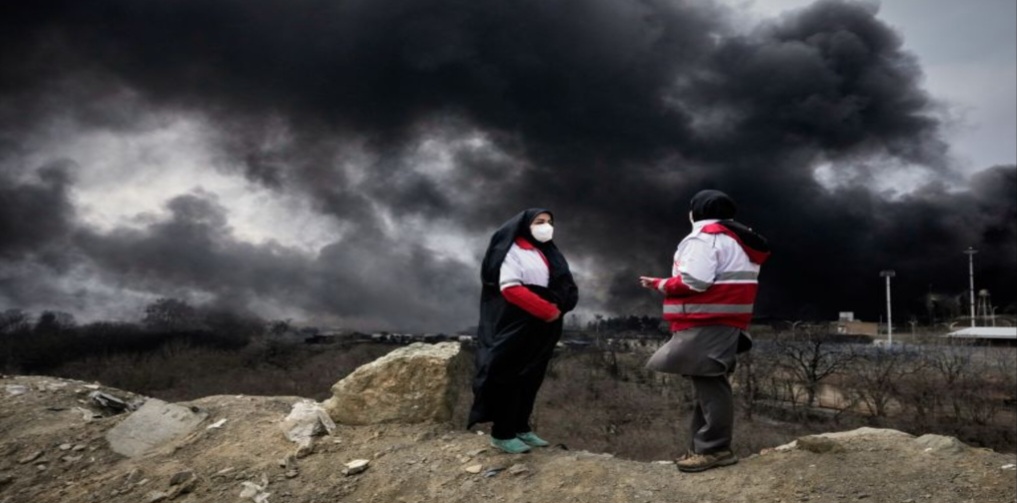
On February 28, 2026, a joint United States–Israeli military operation, codenamed Operation Epic Fury, struck Iran, igniting the most consequential military conflict in the Middle East in decades. While international headlines tracked missile barrages, geopolitical maneuvering, and human casualties, a parallel catastrophe unfolded below the smoke: an environmental emergency with consequences that will outlast the war itself by decades.
This is not a crisis with a single culprit or a single victim. The United States and Israel have struck over 6,000 targets inside Iran across 16 days of operations. Iran has retaliated with missiles and drones against US bases and energy facilities across the Gulf states. Every actor in this conflict has inflicted environmental harm, and every actor’s territory, waters, and people are living with the consequences.
The conflict is not the first between these parties. In June 2025, a shorter 12-Day War between Israel and Iran had already demonstrated how devastating precision strikes on oil and gas infrastructure could be. According to the Bulletin of the Atomic Scientists, those airstrikes caused serious health, environmental, and climate damage, and even those 12 days were enough to raise alarms among scientists worldwide.
A strike on the Tajrish neighbourhood in northern Tehran ruptured a water main, cutting off water access across parts of the city. Kaveh Madani, director of the UN University Institute for Water, Environment and Health, noted that the loss of water access “impacted human health and sanitation” across the capital.
Tehran’s bowl-shaped geography, encircled by mountains that trap air pollution, makes atmospheric contamination far more dangerous than in open terrain. The 2025 war was a blueprint. The 2026 escalation followed it at a far larger scale.
Any honest accounting of the environmental damage in this war must begin with the scale of the offensive campaign. According to US CENTCOM, Operation Epic Fury struck over 6,000 targets in its first 13 days, deploying B-1, B-2, and B-52 bombers, F-22 and F-35 fighters, two nuclear-powered aircraft carriers, 14 guided-missile destroyers, and hundreds of cruise missiles. More than 200 fighter aircraft flew daily.
The US military is, according to the Bulletin of the Atomic Scientists, the largest individual non-country greenhouse gas emitter in the world. B-2 Spirit stealth bombers flew 34-hour round-trip missions from Whiteman Air Force Base in Missouri, a journey of roughly 14,000 miles per sortie. As Doug Weir, Director of the Conflict and Environment Observatory (CEOBS), puts it plainly: “Because all your tanks, missiles, and aircraft burn fuel that’s a greenhouse gas. Then a lot of the munitions also use greenhouse gas to get to where they need to go. Then when munitions are used, there is ecosystem destruction.”
The cumulative emissions from sustaining two carrier strike groups and a continuous bomber rotation represent an enormous, and entirely unaccounted-for, carbon burden.
The strikes themselves release far more than explosive force. Airfields targeted, including Mehrabad International Airport in Tehran, contain large fuel stores whose destruction releases PFAS ‘forever chemicals’ from firefighting foams, alongside heavy metals and dioxins. Israeli strikes on the South Pars gas complex near Kangan and the Fajr Jam gas plant, as documented by the Gulf International Forum, released particulate matter, nitrogen oxides, carbon monoxide, sulfur dioxide, and volatile organic compounds including formaldehyde.
According to CEOBS, ballistic missiles from all parties also pose threats to the upper atmosphere, where rocket fuel combustion produces soot, nitrogen compounds, and chlorine gases that damage the ozone layer. The stratosphere has no rainfall to wash pollutants away. As the renowned environmental scientist Barry Commoner observed decades ago: “The first law of ecology is that everything is connected to everything else.” In this war, the connections are lethal.
As of March 10, 2026, CEOBS had identified over 300 environmentally harmful incidents, 232 of which have been assessed for environmental risk. These span Iran, Iraq, Israel, Lebanon, Kuwait, Jordan, Cyprus, Bahrain, Qatar, the UAE, Saudi Arabia, Oman, and Azerbaijan. No country within 2,000 km of Tehran has been untouched.
Typical pollutants at military sites include fuels, oils, heavy metals, energetic materials, PFAS, and PFOA. When fires ignite, as they frequently do, they add dioxins and furans to the toxic mix. A particular concern is Iran’s liquid-fuelled ballistic missiles, some based on Soviet SCUD designs using unsymmetrical dimethylhydrazine (UDMH) as fuel, a substance so acutely toxic it has caused serious environmental disasters in Afghanistan, Libya, and Ukraine when missile sites were damaged.
With over 400 missiles fired by Iran in its initial barrages, these chemical risks multiply across the entire theatre of conflict.
On March 8, 2026, Israeli drone strikes hit oil depots and refineries on the outskirts of Tehran, a megacity of 10 million people. According to Al Jazeera, spilled oil ignited rivers of fire, thick black smoke blanketed the city, and streets were coated in soot. Because the strikes happened at night, millions of people were exposed to fumes while they slept.
Researchers speaking to Nature found the black rain that followed likely contains cancer-causing benzene, acetone, toluene, and methylene chloride. Gabriel da Silva, an atmospheric chemist at the University of Melbourne, described it as “incredibly high levels of ambient air pollution.”
Iran’s deputy health minister Ali Jafarian confirmed that acid rain is already contaminating soil and water supplies, posing life-threatening risks to children, the elderly, and those with respiratory conditions. Amnesty International noted that Iran’s Foreign Minister Abbas Araghchi described the strikes on fuel depots as “ecocide.”
WHO Director-General Tedros Adhanom Ghebreyesus added that damage to petroleum facilities “risks contaminating food, water and air, hazards that can have severe health impacts especially on children, older people and people with pre-existing medical conditions.”
The environmental toll of this war is not confined to Iran. Iran’s retaliatory campaign has targeted US military bases and energy infrastructure across Bahrain, Kuwait, Qatar, Saudi Arabia, and the UAE.
According to Amnesty International, officials from all five Gulf Cooperation Council countries confirmed that Iranian drones and missiles directly targeted oil and gas facilities, and that debris from intercepted attacks caused additional fires at nearby sites. On March 5, 2026, an Iranian missile struck a refinery unit at Bahrain’s state-owned Bapco Energies, causing a fire and forcing the company to declare force majeure on its oil shipments.
On March 2, two drones targeted the Saudi Aramco Ras Tanura oil refinery, one of the world’s largest export terminals processing 6.5 million barrels per day. Falling debris still ignited a fire inside the facility. On March 10, a drone attack set off a fire at the Ruwais Industrial Complex in Abu Dhabi and another at a fuel tank near Dubai International Airport. For the Gulf states caught between the two sides, this has translated directly into burning refineries, contaminated air, and disrupted water desalination infrastructure.
Perhaps the most consequential environmental victim of this war is the Persian Gulf itself, a shallow, enclosed, and fragile marine ecosystem shared by eight nations. Iran’s effective blockade of the Strait of Hormuz, through which roughly 20% of the world’s oil and LNG flows, has driven vessel insurance costs so high that Strait traffic has been cut by 80%, with approximately 150 crude and LNG tankers anchored in the Gulf.
During the 2025 conflict, two oil tankers collided in the Persian Gulf, generating an 8 km oil slick. CEOBS noted that GPS spoofing linked to electromagnetic warfare may have contributed, a risk still present today with hundreds of large vessels anchored in confined waters amid active combat.
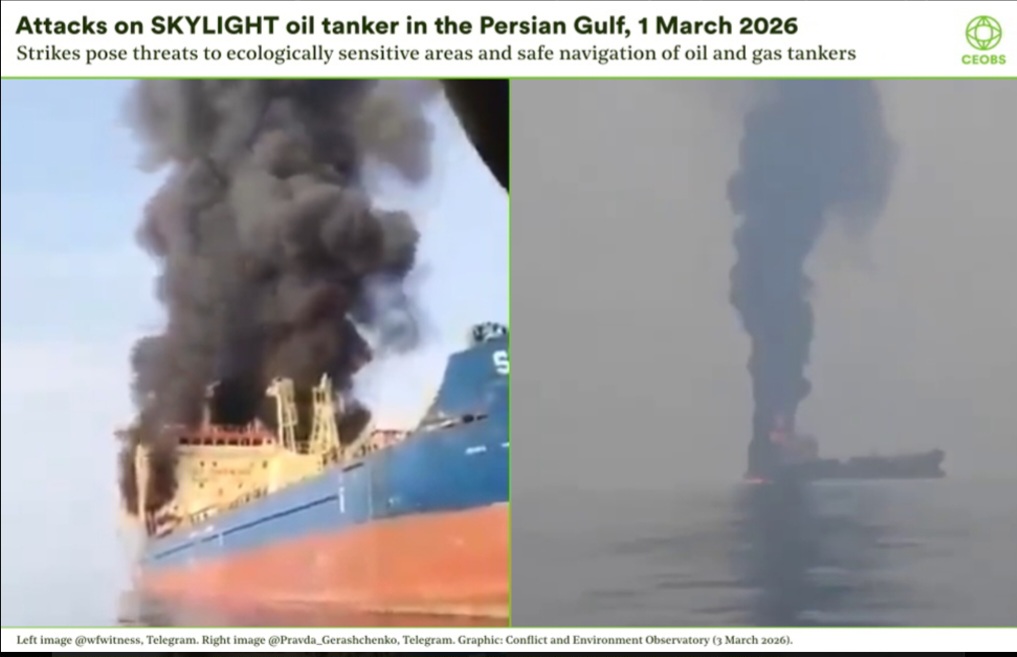
The energy disruption sent Brent crude past $100 per barrel and European gas futures up 67% in a single week, pushing consumers and industries globally back toward dirtier, cheaper fuels, undoing years of clean energy transition progress far beyond the region’s own borders.
Ecological damage does not respect military objectives. Fires burned through the ancient oak woodlands of the Zagros mountains and protected areas in Lorestan and Kermanshah. Wetlands in Gilan were damaged.
Dr. Naghmeh Mobarghaee Dinan of Iran’s Supreme Council for Environmental Protection noted that the strikes coincided with peak nesting, migration, and seed production periods, threatening to disrupt breeding and migratory patterns for years. Bright flashes from missile strikes disoriented migratory birds and nocturnal species.
Vibrations from bombardments ruptured eardrums in animals and disrupted cardiovascular rhythms in wildlife near blast zones. Airborne pollutants and disrupted hydrological cycles are affecting neighbouring countries via dust transport and Gulf water contamination. No ecosystem in the region, not the Gulf’s coral and mangrove habitats, not the wetlands of southern Iraq, not the forests of Lebanon, is insulated from the war’s reach. As the conservationist Jane Goodall has said: “You cannot get through a single day without having an impact on the world around you. What you do makes a difference, and you have to decide what kind of difference you want to make.” Wars make the worst kind.
The destruction of Iran’s forest cover carries consequences that extend far beyond the immediate conflict zone. Iran’s forests cover barely 7% of the country’s land area and are already critically threatened. The Zagros mountain ecosystem stretches across 11 provinces and is home to over 1,100 plant species, including endemic varieties found nowhere else on Earth.
According to Iran’s Department of Environment, the Zagros oak forests sequester an estimated 420 million tonnes of carbon dioxide equivalent. Burning even a fraction of that stored carbon accelerates the very climate crisis the region’s fragile agricultural systems least afford. Iran’s Forest, Range and Watershed Management Organisation has warned that reforestation of the affected zones, even under optimal conditions, will require 40 to 70 years.
The disruption of water infrastructure compounds every other crisis. Iran’s water system, already strained by decades of mismanagement and drought, has been further destabilised by the conflict. At least 14 water treatment facilities across Tehran, Isfahan, and Ahvaz have been rendered inoperable or severely damaged, cutting safe drinking water access for an estimated 4.2 million people.
Wastewater systems overwhelmed by bombing damage are discharging untreated sewage into the Karun and Zayandeh rivers, two of Iran’s most agriculturally critical waterways. The UN Office for the Coordination of Humanitarian Affairs (OCHA) has flagged the risk of a secondary public health catastrophe as waterborne diseases including cholera and typhoid spread in areas where sanitation networks have collapsed.
The World Health Organization estimates that for every direct conflict fatality, wars of this scale and duration historically produce 1.7 to 2.3 additional deaths from disease, malnutrition, and environmental exposure. In a country of 88 million with a compromised healthcare system already under sanctions-related strain, the cascading consequences of environmental destruction may ultimately claim far more lives than the missiles themselves.
One of the most alarming unknowns concerns Iran’s nuclear infrastructure. The IAEA has stated that “nuclear facilities must never be attacked, regardless of the context or circumstances, as it could harm both people and the environment.”
A specific concern is uranium hexafluoride (UF6), which reacts with atmospheric moisture to produce hydrofluoric acid, capable of severe chemical burns and corrosion across a wide area. With phone and internet communications to Iran largely cut since February 28, independent sampling and verification are nearly impossible.
Researcher Nazanine Moshiri told The Japan Times: “It’s necessary for accountability and cleanup when the conflict ends.” That accountability, for now, does not exist.
Every party to this conflict, the United States, Israel, and Iran, is contributing to an environmental catastrophe for which none will face formal reckoning. Militaries remain largely exempt from international climate accountability.
While nations are encouraged to report emissions under the Paris Agreement, they are not required to disclose the environmental impact of their military operations. According to CSIS, the first 100 hours of Operation Epic Fury cost the US approximately $3.7 billion, mostly unbudgeted. That figure covers sorties, munitions, and personnel.
It includes no environmental remediation, no carbon offset, no ecological liability. No such accounting exists, and under current international law, none is required. As Covering Climate Now reports, this war is also diverting political capital away from COP30 in Brazil, systematically undermining the diplomatic cooperation the climate crisis most urgently needs.
Beyond emissions and direct pollution, the war has triggered a secondary global environmental crisis through its disruption of energy markets. The International Energy Agency estimates that the effective closure of the Strait of Hormuz has removed approximately 18 million barrels of oil equivalent per day from global markets.
To compensate, coal consumption in Europe and Asia surged by 23% in March 2026 alone, reversing three years of measured decline. In Germany, mothballed coal plants were brought back online within 72 hours of the conflict’s outbreak. In South Asia, where energy poverty is already acute, the spike in LNG prices forced utilities to extend blackouts and switch to diesel generators, producing a measurable increase in urban particulate matter.
Carbon Brief analysis projects that this single month of conflict-driven fossil fuel substitution may add as much as 380 million tonnes of CO₂ equivalent to the global annual emissions total, roughly equivalent to the entire annual footprint of South Korea. The climate mathematics of this war extend to every continent.
The Iran–Israel–USA war has created a rolling environmental catastrophe, one that expands with each passing day. Black acid rain over Tehran. Burning refineries in Bahrain and Abu Dhabi. Oil tankers colliding in the Persian Gulf. B-2 bombers on 34-hour fossil-fuel sorties from Missouri. Ancient oak forests burning in Lorestan.
A global energy market spiralling toward dirtier fuels. This is not Iran’s environmental crisis, or Israel’s, or the Gulf states’. It is everyone’s. Pollutants released into the atmosphere do not stop at borders. Oil slicks spread across shared waters. Greenhouse gases accumulate in the same sky above all of us. The environment has no allegiance to any flag.
Unlike military infrastructure, ecosystems do not rebuild when a ceasefire is signed. Pollutants persist in soil and water for decades. Forests scarred by fire take generations to recover. The damage being inflicted now, invisible amid the fog of war, will compound pre-existing environmental crises across the region for years after the last missile lands. Dr. Kamiar Madani offered the simplest and most urgent truth: “Anyone who cares about the environment should also care about peace.”




.jpeg)


Comments
No comments yet. Be the first 🙂