


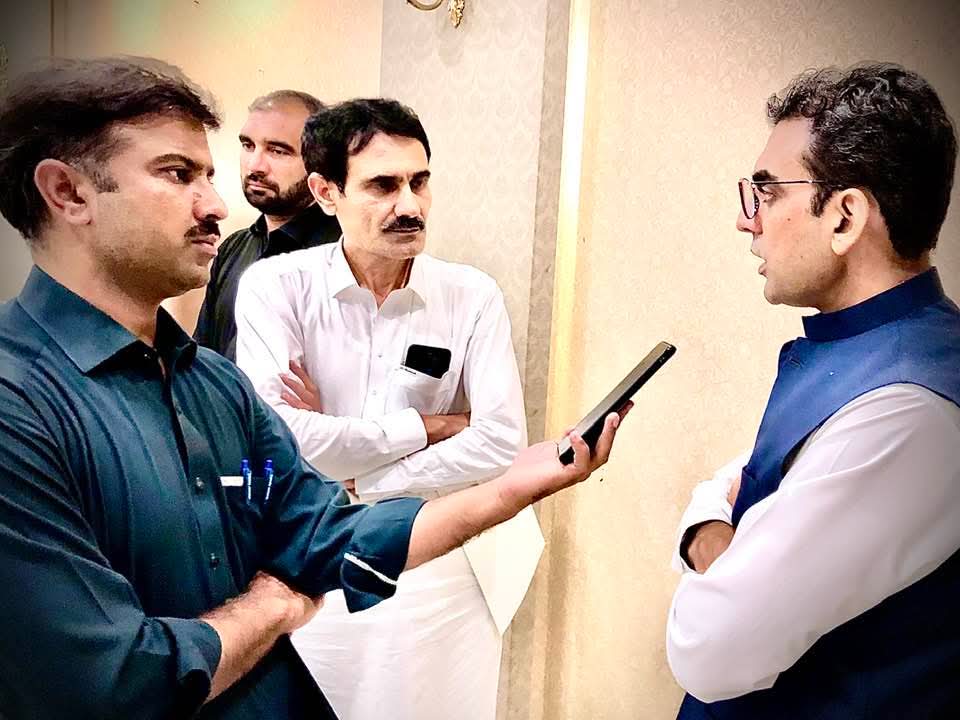
In Khyber Pakhtunkhwa’s Charsadda district, journalists have yet to see an FIR registered despite receiving threats of being targeted in a bomb attack, sparking serious concern within media circles.
Members of the Charsadda Press Club have been under mental stress and uncertainty for the past two months, alleging a lack of seriousness on the part of the police.
“Your fate will be at Bacha Khan Chowk”
On the evening of December 2, 2025, journalist Rafaqatullah Razarwal was at the Charsadda Press Club with colleagues when he received a voice message on his mobile phone.
The sender claimed to represent a banned militant organization and threatened that he would be targeted in a bomb blast at Bacha Khan Chowk.
Also Read : The Price of Truth: Journalists Under Pressure in Tribal Districts
Razarwal has been associated with journalism for the past 13 years and is currently working as a reporter for Tribal News Network.
He says the alleged reason for the threat was videos he produced on public issues and uploaded to his YouTube channel.
According to him, he had fully adhered to journalistic ethics and code of conduct. However, that single message has caused severe psychological distress not only to him professionally but also to his entire family.
These threats are not limited to Razarwal. Senior journalist Syed Shah Raza has also received similar warnings. The 63-year-old journalist has been working in the field for 39 years and is currently associated with Radio Umeed Charsadda and his own YouTube channel.
He says, “I believe death comes at its appointed time, but my complaint is that our FIR has still not been registered.”
Why hasn’t the FIR been registered?
According to Razarwal, after receiving such a serious threat, he expected immediate legal action. However, when he went to the City Police Station, the SHO recorded the complaint in the daily diary instead of registering an FIR and advised him to exercise caution and carry a weapon.
Charsadda Press Club President Sabz Ali Khan, who has held the position since 2019, says the police are displaying non-serious behavior.
He adds that when they met the District Police Officer of Charsadda, the officer claimed to be unaware of the matter, which was extremely disappointing.
On the other hand, the SHO of the City Police Station maintains that after the threat, he visited the press club along with the DSP.
Since the matter involved terrorism, an initial report was prepared and sent to the Counter Terrorism Department (CTD).
However, CTD officials state that there were technical flaws in the police report, due to which the file was returned to the City Police Station a week ago.
Syed Shah Raza alleges that instead of providing security after they raised their voice, two police personnel deployed at the press club were withdrawn.
He claims that the DPO is taking administrative actions, partly because of their protest for FIR registration and partly due to a news report on electricity theft that led to action by WAPDA.
A tense environment and professional risks:
In a conflict-affected region like Khyber Pakhtunkhwa, practicing journalism is not merely about reporting news—it is akin to fighting a battle for survival.
Journalists here face dual pressure: on one side, the sensitivity of the state and security institutions, and on the other, threats from banned militant groups.
In such a violent environment, access to information is limited, and even a minor mistake can prove fatal.
While reporting on sensitive issues, journalists must consider not only their own safety but also that of their families.
Often, they have to calculate their security before speaking the truth—an undeclared pressure that has increasingly constrained freedom of expression.
Freedom Network report on journalists’ safety:
According to a recent report by Freedom Network, Khyber Pakhtunkhwa has become the second most dangerous province in the country for journalists.
Between May 2024 and April 2025, five journalists were killed nationwide, two of them from this province.
Last year, Hassan Zeb was killed in July, Khalil Jibran in June, and Kamran Dawar in May. These incidents indicate that threats often turn into real dangers.
According to Syed Shah Raza, “Khyber Pakhtunkhwa is turning into hell for journalists. When a news idea comes to mind, you first have to think whether you will return home alive.”
He adds that while senior journalists may stand their ground to some extent, many junior journalists are being forced to leave the profession out of despair.
Protest warning, government claims remain:
Sabz Ali Khan has announced that if the FIR is not registered immediately, they will stage a protest outside the office of the Regional Police Officer in Peshawar.
“When the state cannot provide protection to its citizens, it becomes a red flag for press freedom,” he said.
Provincial Information Adviser Shafi Jan has stated that the government is serious about the protection of journalists and will not ignore any threats.
However, the continued failure to register the FIR has raised serious questions about these claims.
Journalism or a battle for survival?
Rafaqatullah Razarwal continues to report in the field, but at every step he recalls the voice message threatening to target him at Bacha Khan Chowk.
In journalistic circles in Charsadda and Peshawar, a pressing question remains: will state institutions be able to provide effective protection to their citizens, or will protest be the only option left to compel authorities into serious action?
.jpeg)
Comments
No comments yet. Be the first 🙂