


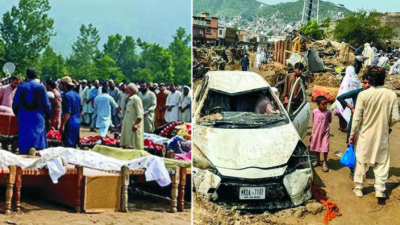
It feels as if Bajaur has been struck by an evil eye, finding itself caught in an extraordinarily grave dual crisis. On one hand, a somber atmosphere hangs over the district due to civilian casualties from the ongoing operation against terrorists; innocent people, including children, are losing their lives, while others flee in fear and desperation. Amid this turmoil, torrential rains, flash floods, and landslides have only worsened the suffering and hardships of Bajaur’s people.
Several other districts, including Buner, Swat, Lower Dir, Mansehra, and Battagram, have also been hit by flooding, but Bajaur and Buner have borne the worst devastation. The floods struck an area of Salarzai Tehsil in Bajaur, sweeping away 21 lives, while 17 others remain missing. Among them were two brothers; the body of one has been recovered, while the other is still being searched for. These numbers are not small, for every individual represents an entire family torn apart.
Just days ago, terrorists had bombed a police checkpoint in Salarzai, leaving residents already gripped by fear. Now, storms, high winds, and relentless downpours have pushed them to the brink of despair.
Also Read: Climate Change and Cloudbursts: A Growing Threat for Northern Pakistan
Rescue 1122 teams struggled to reach affected areas, with some locations completely inaccessible despite their best efforts. To make matters worse, a helicopter dispatched by the Khyber Pakhtunkhwa Chief Minister to deliver relief goods to Bajaur crashed in Chengay Banda, killing five people, including two pilots. Those who set out to save lives tragically lost their own.
Why do we always wake up when it’s too late? Mountainous regions lack basic facilities, and when floods hit, coping with the situation becomes nearly impossible.
It is worth noting that most people in Bajaur depend on livestock and agriculture for their livelihood. Whenever law and order deteriorates or floods strike, they lose not only their animals and crops but also their homes, homes built with years of hard-earned savings.
For Bajaur’s people, livestock and crops are more precious than life itself because they are the backbone of survival. Losing them means losing everything.
All I can say in the end is this: build homes in safer areas, away from flood-prone zones, and avoid settling where floods have previously occurred. We must learn lessons from the destruction caused by these floods and take preventive measures. The Disaster Management Authority should issue timely alerts so people can relocate to safer places before disaster strikes.
The government deserves credit for reaching out to the victims, though this is its fundamental responsibility. Yet, had preventive steps been taken earlier, perhaps this catastrophe could have been averted. Both the government and the Disaster Management Authority, along with the general public, must adopt measures that can mitigate the impact of future disasters.
Climate change is affecting the entire world at an alarming scale. There is still time to implement environment-friendly policies, or else in the years to come, the consequences of climate change will be far more devastating.




.jpeg)
Comments
No comments yet. Be the first 🙂